
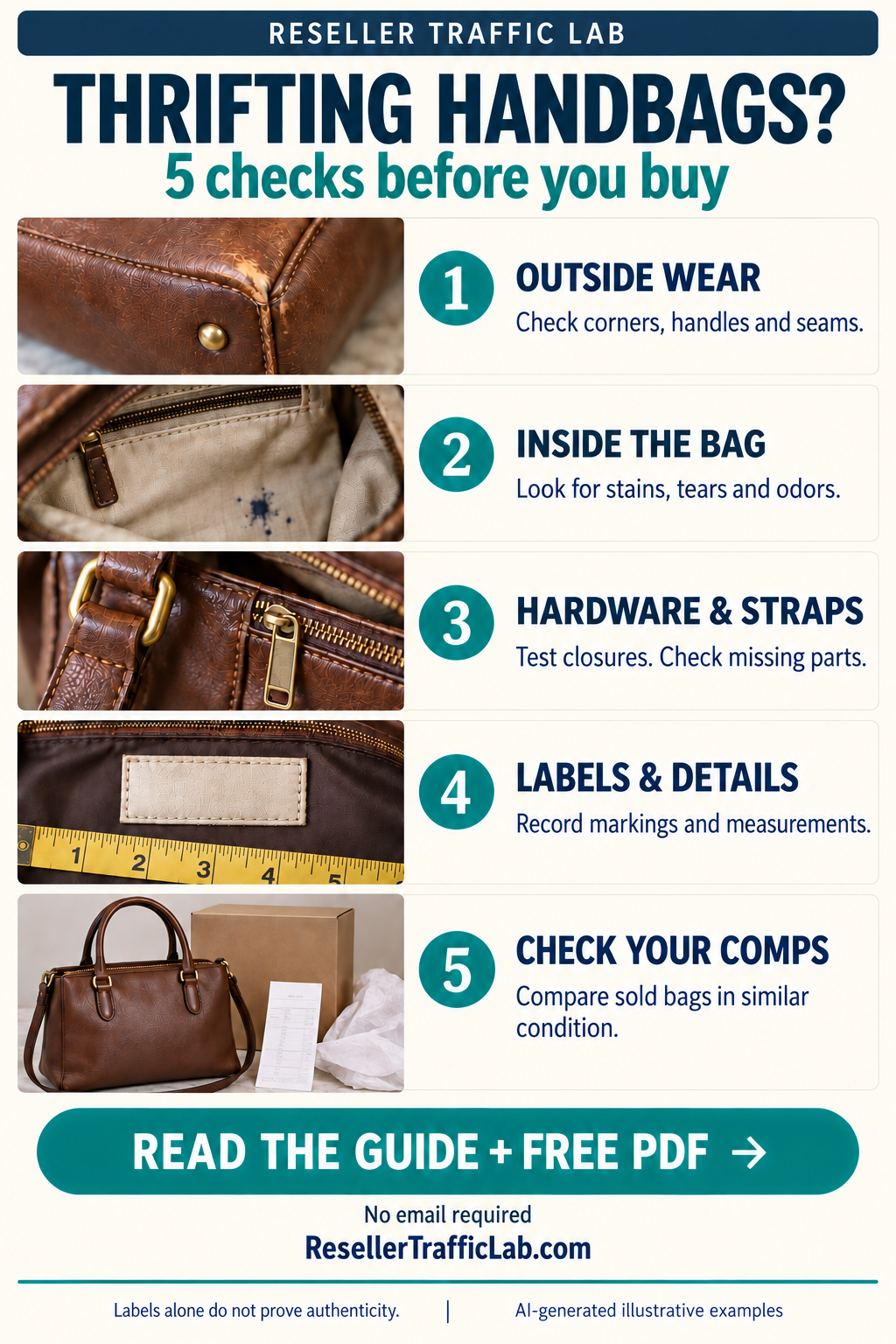
1. Outside wear
Look closely at corners, handles, seams and strap attachments. Check for peeling, cracks, rubbed edges, stains and repairs. Inspect the underside, where wear is easy to miss.
Why it matters: Decide whether the condition is something you can accurately show and sell.
2. Inside the bag
Open every pocket. Look for ink, makeup stains, sticky or peeling lining, tears and loose seams. Check for noticeable odors. Do not assume stains or smells will come out.
Why it matters: Avoid buying a cleanup project without counting the work and uncertainty.
3. Hardware and missing parts
Test each zipper, snap, clasp and strap adjuster gently. Check stitching around attachment points. Note a missing shoulder strap, zipper pull, lock, key or other accessory when applicable.
Why it matters: Missing or damaged parts can change the value and the buyer's expectations.
4. Identification you can support
Photograph the brand label, style or model code, material label and any origin markings. Record the bag's measurements and strap drop. A logo or serial number alone does not prove authenticity.
Why it matters: Identify the closest comparable bag and write an accurate description.
5. Check your comps
Compare sold bags of the same brand and model with similar size, material, condition and included accessories. Then count your purchase price, shipping, packaging, fees and any cleaning or repair cost.
Why it matters: Compare sold bags in similar condition, with similar accessories. Then decide whether the likely profit is worth your costs and time.
Buy it or leave it?
A low price is only a good deal if the bag is worth your costs and time. Make the decision based on its condition today.
- Consider buying: Closely matched sold bags support your price, the closures and straps work, and you can clearly describe and photograph the condition.
- Pause and count the cost: Missing straps, worn corners or stains may lower the selling price. Compare bags with the same issues and price any replacement parts before buying.
- Usually leave it: Peeling material, sticky lining, strong odors or broken closures can turn a cheap bag into a project. Pass unless you already know the repair cost and can still justify the work.
- Unsure it is genuine? Do not buy a branded bag for resale on the assumption that a label or serial number proves authenticity.
Quick decision: Would you still buy it if the stain or smell never came out? If not, leave it.
A $6 purse that might sell for $25
Imagine similar bags in the same condition have sold for about $25 with free shipping. That does not mean you keep $19.
| Illustrative sale and costs | Amount |
|---|---|
| Selling price, with free shipping | $25 |
| Purchase price | −$6 |
| Selling-fee allowance | −$4 |
| Shipping label | −$6 |
| Packaging | −$1 |
| Cleaning supplies used | −$1 |
| Left after these costs | $7 |
Is $7 worth your time? Consider the cleaning, photos, listing, packing and any return risk. If it needs another $5 in parts or cleaning, only $2 remains after these costs.
Example only—not a promised sale price or an exact eBay fee quote. The $4 fee allowance is a placeholder. Your category, order total, Store plan and promotional fees can change the result. The $7 is before income tax, your labor, overhead and any returns.
Use your own numbers in the free eBay profit calculator before buying. Check shipping using the packed bag’s weight and size.
Before you clean a handbag
Start with the material, not the stain. Check the maker’s instructions for the exact bag, including its lining and trim. If the material or finish is uncertain, ask the maker or a handbag-care specialist before using a product.
Empty the pockets and gently remove loose debris. Photograph the condition first. Test any permitted cleaning product on a hidden area and let it dry fully before continuing. Stop if color transfers or the surface changes.
What can I use to clean it?
Match the product to the bag’s material and finish. These examples follow the makers’ guidance; they are not safe-for-every-bag recommendations.
| Material | What to use | Important limit |
|---|---|---|
| Compatible Coach leather | Coach leather care instructions; moisturizer only where approved. | Check Coach’s list of compatible leathers. Not for suede, haircalf or Sport Calf. Do not assume it suits other brands. |
| Suede | A suede brush or suede eraser, used gently. Coach’s suede guidance. | Use only where the maker permits dry care. Avoid water and ordinary leather creams. |
| Coated canvas | A soft cloth with slightly soapy water, where permitted. Louis Vuitton’s canvas guidance. | No leather conditioner on canvas. Protect leather trim and avoid printed decoration; follow the exact bag’s instructions. |
| Nylon | A soft cloth dampened with water as a starting point. Longchamp’s nylon guidance. | A bottled cleaner may be unnecessary. Follow the maker’s full directions; do not soak the whole bag or its trim. |
| Fabric or jacquard | A dry or slightly damp soft cloth, as the care label allows. Coach’s fabric guidance. | Fabric does not mean machine-washable. Lining, backing and trim may need different care. |
On a small screen, swipe the chart sideways to read all three columns.
Before using a product: Check the maker’s instructions first. Test any permitted product in a hidden spot and let it dry before treating more of the bag. Advice for the body may not apply to its trim or lining.
For unidentified leather, fragile vintage finishes or peeling faux leather, ask the maker or a handbag-care specialist before choosing a cleaner. A cleaner cannot repair peeling.
Stains, odors and damage
Do not soak the bag, scrub delicate surfaces or use heat to dry it. Avoid improvised solvent or household-cleaner treatments. For ink, persistent odors, fragile finishes or valuable bags, get a professional assessment before trying to remove the problem.
Cleaning will not repair peeling, cracks or missing parts. Do not buy on the assumption that every stain or smell will come out. Include the likely cleaning cost and time in your buying decision, and disclose any remaining issues when you list.
These are starting points, not a universal cleaning recipe. The maker’s instructions for your particular bag take priority. Cleaning tips added October 14, 2026.
Before you list a branded bag
This checklist does not authenticate handbags. If you are unsure a branded bag is genuine, resolve that before listing. A label, serial number or dust bag alone is not proof. eBay allows an item to be listed only when you are certain it is genuine.
Check the numbers before buying
Use comparable sold prices for the same brand and model in similar condition. Then use the free eBay profit calculator to include your purchase cost, shipping, packaging and fees. Count any cleaning or repair cost and consider the time involved.