
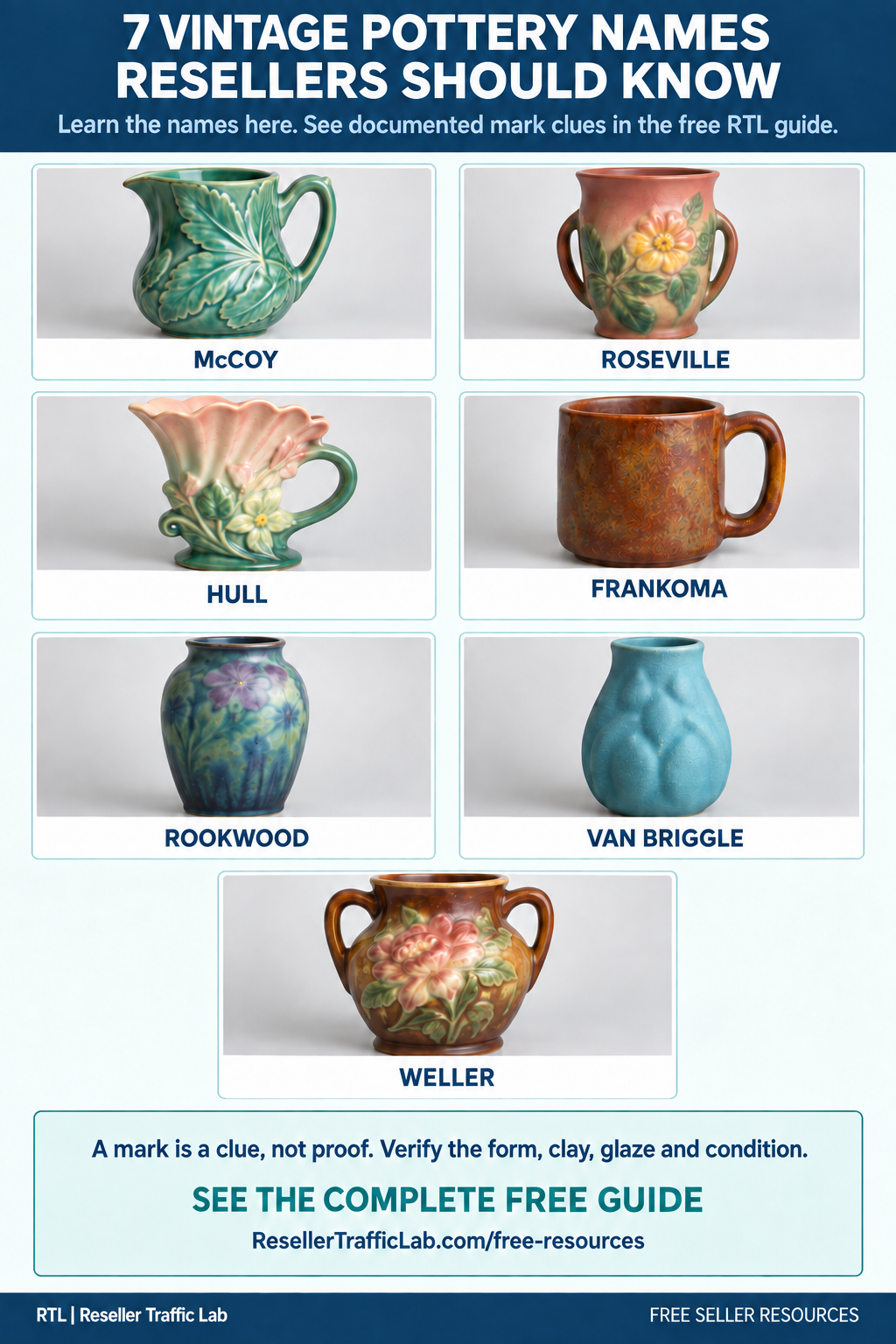
Quick answer: Begin with McCoy, Roseville, Hull and Frankoma for practical sourcing recognition. Add Rookwood, Van Briggle and Weller for American art pottery. A recognizable name is only the beginning: the complete piece still has to match.
Seven vintage pottery names worth recognizing
This is a reseller watchlist, not a promise that every piece is valuable. The first four are useful everyday sourcing knowledge; the final three deserve extra attention because artist, glaze, age and form can matter greatly.
| Maker | Marks you may encounter | Common finds | Before you identify it |
|---|---|---|---|
| McCoy | NM, McCoy, McCoy USA or maker-specific marks; some genuine pieces are unmarked or marked only USA. | Planters, vases, cookie jars, kitchenware and decorative pieces. | The company reused forms and changed marks. A McCoy-looking mark alone is not enough, and reproductions exist. |
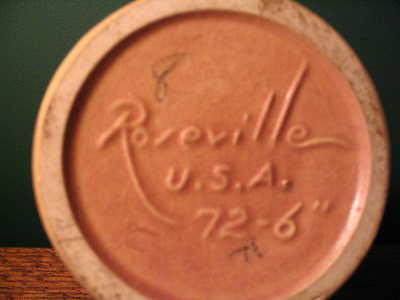
| Roseville | Roseville, Roseville USA, Rozane-related marks, paper labels, shape numbers or no permanent mark, depending on the line and period. | Floral art-pottery vases, bowls, jardinieres and planters. | Confirm the pattern, shape number, size and glaze. Reproductions and fantasy pieces make shape-level verification important. |
| Hull | Hull, Hull Art U.S.A., Hull Ware, a capital H in a circle or diamond, line names, numbers or labels. | Artware vases, planters, kitchenware, cookie jars and novelty pieces. | Hull used many mark systems, and some genuine lines were not marked Hull. Match mold and size numbers to a documented line. |
| Frankoma | Frankoma name marks, mold numbers and marks that changed across production eras. | Prairie Green and Desert Gold tableware, mugs, political mugs, planters and decorative ware. Early pieces used light beige Ada clay; around 1953–1954 production changed to a more reddish Sapulpa clay. | Collectors may call an early piece “Ada-clay Frankoma,” but Ada is the clay source, not another maker. Clay color and glaze are supporting clues and do not prove the date by themselves. |
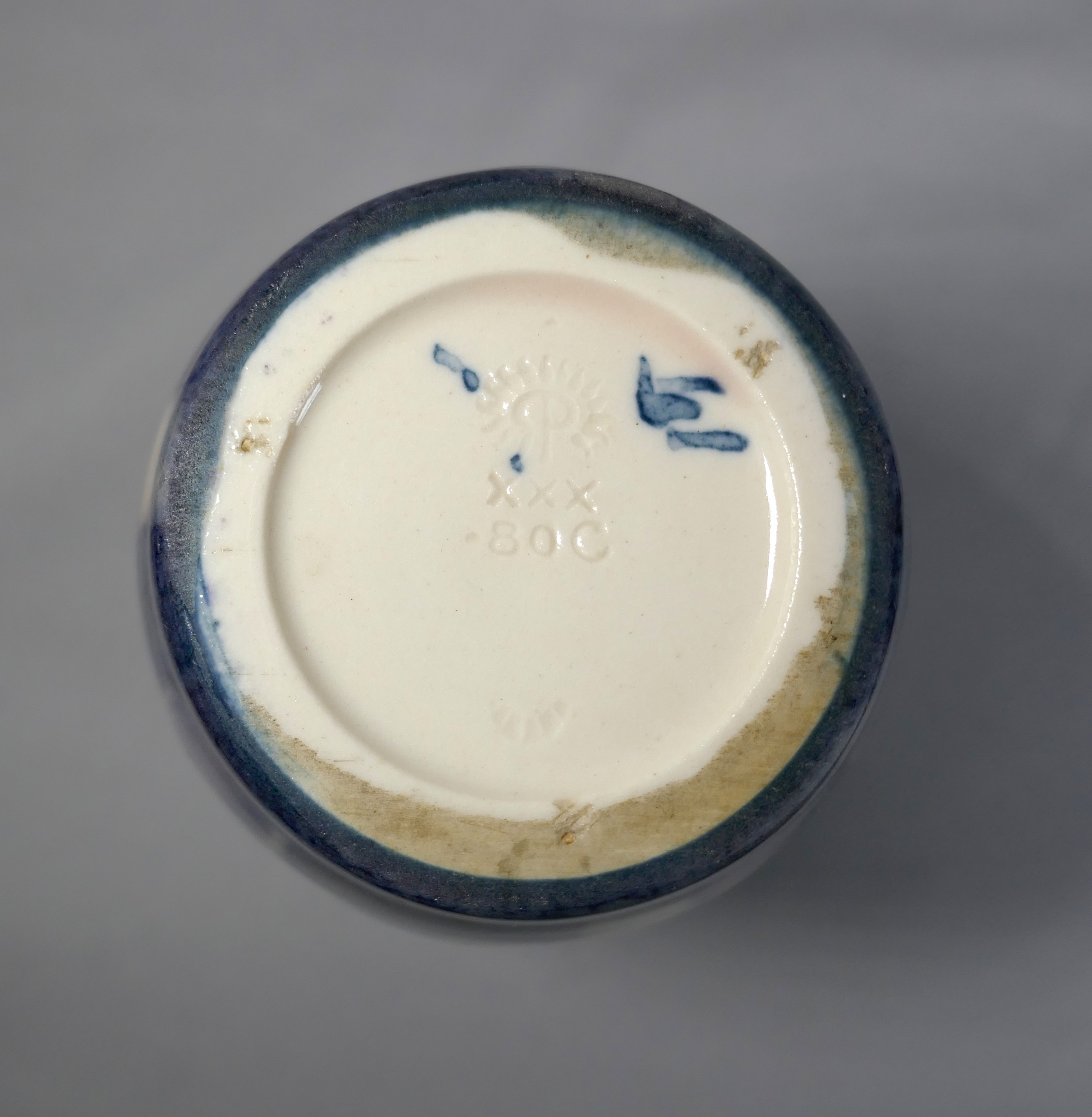
| Rookwood | ROOKWOOD or the conjoined reverse R-P logo; flames, Roman numerals, shape numbers and artist ciphers can also appear. | Art-pottery vases, bowls, tiles and artist-decorated pieces. | Read the factory date system separately from the artist mark. Condition, artist, glaze and form can strongly affect desirability. |
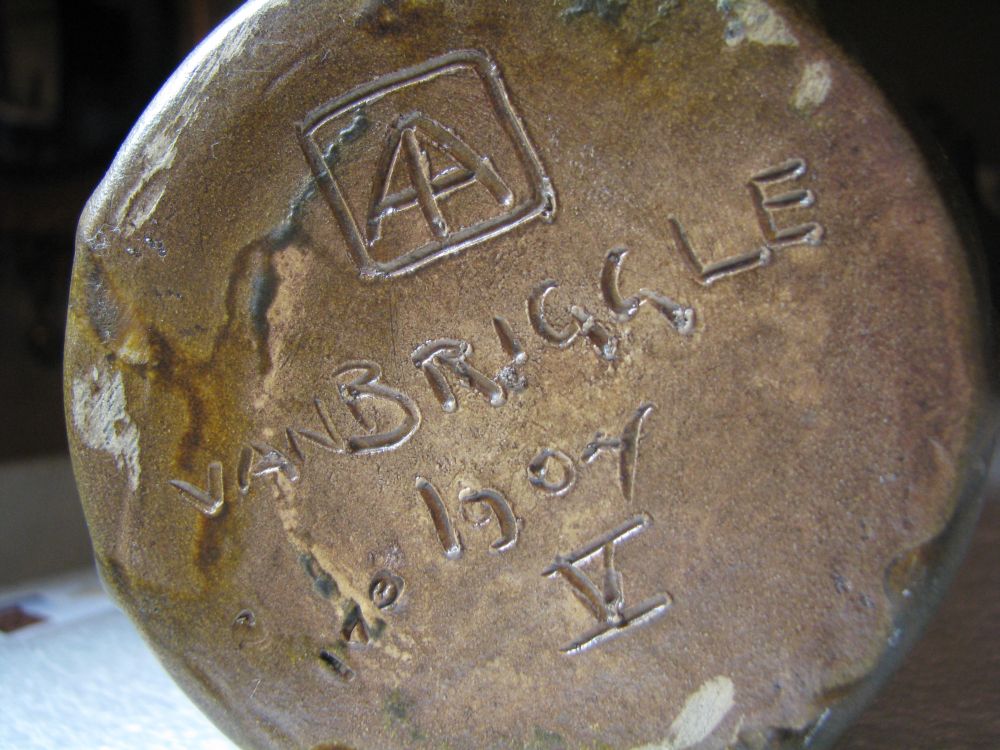
| Van Briggle | The conjoined AA monogram, Van Briggle wording, Colo. Spgs., date information, shape numbers and finisher marks. | Matte-glaze art pottery, vases, bowls, figurals and decorative pieces. | Marks were often hand-incised and naturally vary. Compare clay, glaze, form and the complete underside with documented examples. |
| Weller | Incised or impressed Weller wording, line names, molded script marks, ink stamps or paper labels. | Art-pottery vases, jardinières, planters and molded decorative ware. | Many pieces lost paper labels or were unmarked. Attribute only when the glaze, form, clay and documented line all agree. |
Seven vintage pottery names at a glance
Underside mark examples
The first three examples are real, sourced underside photographs. They show why the entire base matters: a factory logo can appear beside date information, a shape number and an individual artist's mark.


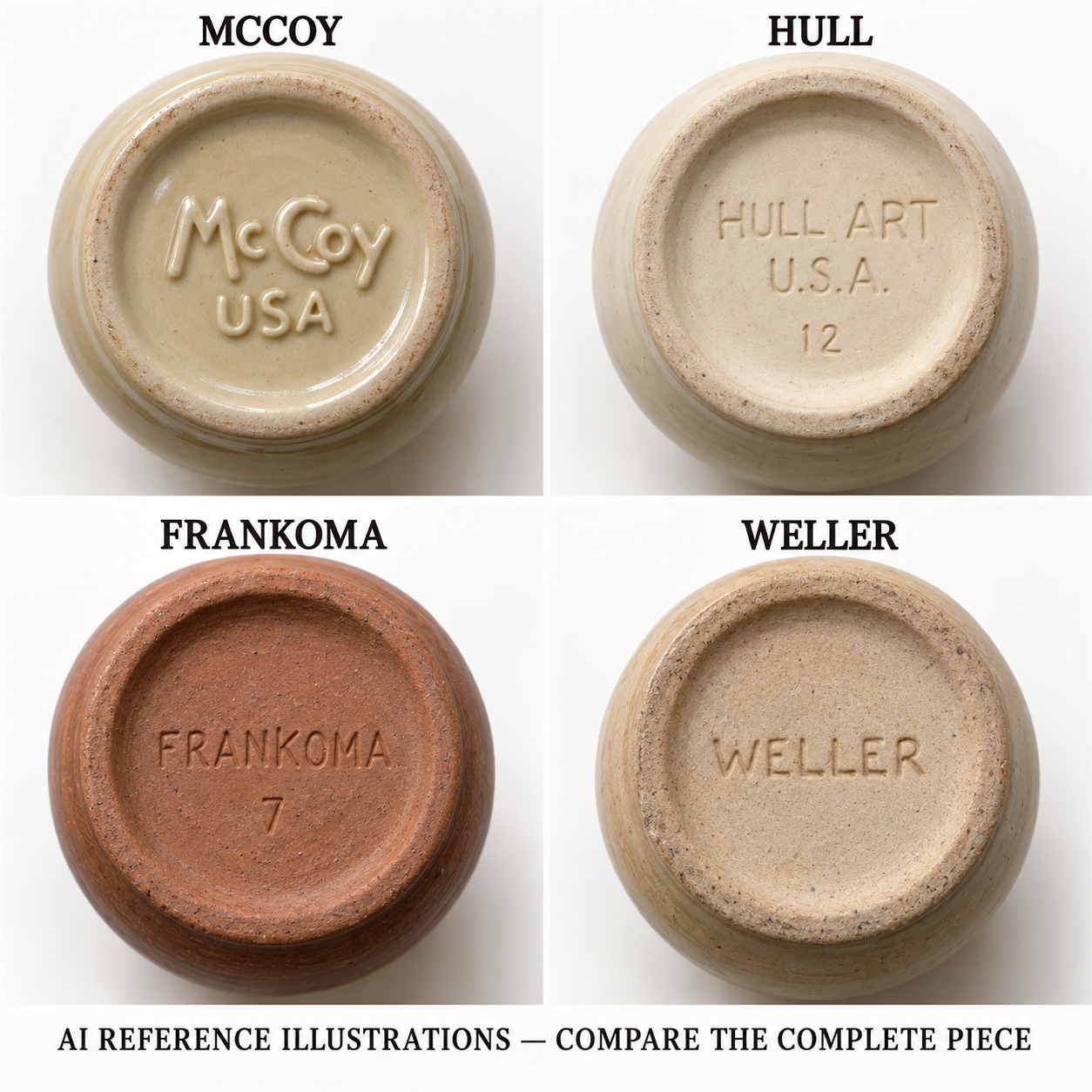
Reference illustrations for four additional makers
The examples below are AI-created recognition aids based on documented mark descriptions. They are not photographs of authenticated pieces and they do not represent every genuine variation.

What kind of mark did you find?
| Mark type | What it may mean | Seller caution |
|---|---|---|
| Printed backstamp | Factory branding, trade names, pattern names or origin wording printed with ink or a transfer. | Match the complete version, not just one crown, animal or set of initials. |
| Impressed or stamped mark | A name, symbol or code pressed into the clay before firing. | Use side lighting because shallow impressions can vanish in a straight-on photograph. |
| Incised signature | Letters or a signature scratched into the clay, often on studio pottery. | Photograph the full form and clay body before guessing the artist. |
| Painted decorator mark | Brush-painted initials, symbols or numbers that may identify a decorator rather than the factory. | Do not automatically treat initials as the maker's signature. |
| Country-of-origin wording | Wording such as ENGLAND, MADE IN ENGLAND, JAPAN or MADE IN JAPAN can narrow the research period. | Origin wording is a clue, not an exact date. |
| Pattern, shape or registration number | A number may connect to a factory pattern book, mold, shape or registered design. | A number is not automatically a date; registration dates are not necessarily manufacture dates. |
Take these five photographs before researching
- The entire object: show the full shape and decoration from a level angle.
- The complete underside: include the foot, clay body, glaze edge and every mark together.
- A close-up of the mark: keep it sharp and square; add side lighting for impressions.
- Construction and texture: photograph the unglazed foot, mold lines, handles, rim and interior.
- Every condition issue: show chips, cracks, crazing, repairs, staining and glaze loss.
Useful clues that are easy to overstate
- ENGLAND: became common on British exports from roughly 1891, but documented exceptions exist.
- MADE IN ENGLAND: became widely used in the early twentieth century, especially after tighter U.S. marking practices around 1914; it is not an exact dating formula.
- Ltd. or Limited: cannot predate the maker's incorporation. Research that company's legal history instead of assigning a universal date.
- British registration diamond or Rd No.: identifies when a design was registered. The object may have been produced later.
- Hand-painted numbers: frequently refer to patterns, decorators or internal production rather than a date.
A repeatable reseller research workflow
- Transcribe every visible word and number exactly, including punctuation.
- Classify how the mark was applied: printed, impressed, incised or painted.
- Search the clearest wording in quotation marks, adding pottery mark, the object type and likely country.
- Compare multiple documented versions because logos and company wording change.
- Confirm that the proposed maker produced that form, clay body, glaze and decoration.
- Compare sold listings only after identification, matching form, size, pattern, condition and completeness.
Common reseller traps
| Mistake | Better approach |
|---|---|
| Assuming every number is a date | Research whether it is a shape, mold, pattern, decorator or registration number. |
| Matching one crown, animal or set of initials | Match the complete mark: border, font, wording, placement and application method. |
| Ignoring an unmarked piece | Use construction, clay, glaze, form and provenance as clues. |
| Using an image-search result as proof | Trace it to a museum, maker archive, specialist reference or documented collector source. |
| Calling crazing proof of age | Crazing has several causes and can be reproduced. Evaluate the complete object. |
| Copying another seller's identification | Verify independently; marketplace titles often repeat earlier mistakes. |
Use language that matches your evidence
When a mark is visible but the maker is not confirmed, say exactly what you can see. Cautious wording protects buyer trust and leaves room for a collector to recognize the piece.
| Evidence | Safer wording | Avoid |
|---|---|---|
| Complete mark matches a documented maker and period | Name the maker and describe the mark; use a supported date range | An exact year without a documented date code |
| Signature is readable but artist is unverified | “Signed studio pottery” followed by the signature as read | Attributing it to a similarly named artist |
| Only numbers or symbols are present | “Marked on base” with a sharp photograph | Presenting the number as a model, year or maker without support |
| No mark is present | “Unmarked pottery” with form, glaze, size and condition details | “Rare unsigned [famous maker]” based only on resemblance |
Reliable places to continue the research
- The Potteries: English Pottery Marks and Dating — wording, origin marks, registration systems and exceptions.
- The Potteries: British Registration Diamonds and Numbers — why registration dates are not manufacturing dates.
- The Potteries: Stoke-on-Trent Resources — marks, trade names, initials and manufacturer histories.
- Smithsonian Libraries: Public-Domain Dictionary of Pottery Marks — an 1879 historical reference.
- Metropolitan Museum of Art: Sèvres Makers and Marks — why letters, numbers and handwriting require care.
Pottery identification is specialized and exceptions are common. This guide is a research starting point, not an authentication or appraisal.