
Pattern recognition is a useful starting point, not final authentication. Confirm the decoration, piece shape, model number, backstamp, lid and condition together before describing a vintage Pyrex item.
Ten pattern families to recognize
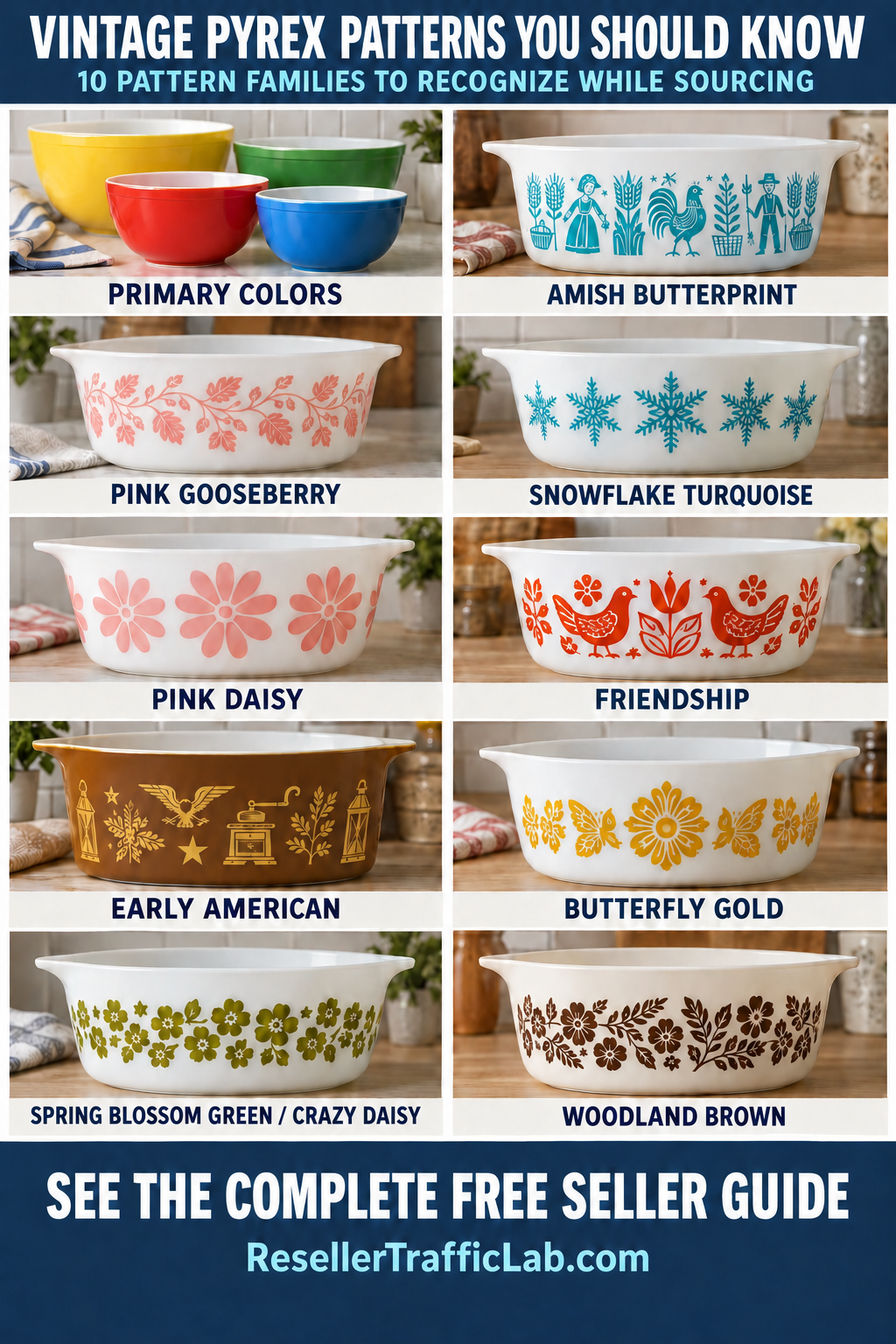
Documented names and useful seller aliases
| Pattern family | Documented production period | What sellers should know |
|---|---|---|
| Primary Colors | 1945-1949 | Solid yellow, green, red and blue nesting mixing bowls. Sellers commonly add mixing bowls or nesting bowls. |
| Butterprint | 1957-1968 | Turquoise-and-white Pennsylvania Dutch farm imagery. Amish Butterprint is a common marketplace search alias. |
| Gooseberry | 1957-1966 | Curved stems, pointed leaves and clustered berries. Pink Gooseberry distinguishes the familiar pink-on-white and white-on-pink versions. |
| Snowflake | 1956-1967 | Turquoise snowflake designs appeared in multiple color arrangements. Do not confuse early Snowflake with the later Snowflake Blue or Snowflake Garland family. |
| Pink Daisy | 1956-1962 | Large pink floral decoration on white opal glass. Pink Daisy is the commonly used marketplace name. |
| Friendship | 1971-1974 | Red and orange Pennsylvania Dutch-inspired birds and flowers. Sellers often add red-orange birds to the title. |
| Early American | 1962-1971 | Colonial motifs including an eagle, coffee grinder and lantern. Some listings add Heritage, but Early American is the documented name. |
| Butterfly Gold | 1972-1981 | Gold or orange floral decoration released in two related versions. The 1979 redesign uses smaller flowers on stems. |
| Spring Blossom Green | 1972-1981 | Green floral decoration released in two versions. Crazy Daisy is a widespread seller and collector alias. |
| Woodland | 1978-1983 | Brown floral, leaf and fern-like decoration. Woodland Brown is a useful marketplace search phrase. |
More common patterns to recognize
These additional families broaden the guide into the 1980s and cover names sellers are likely to encounter while sourcing or researching listings.
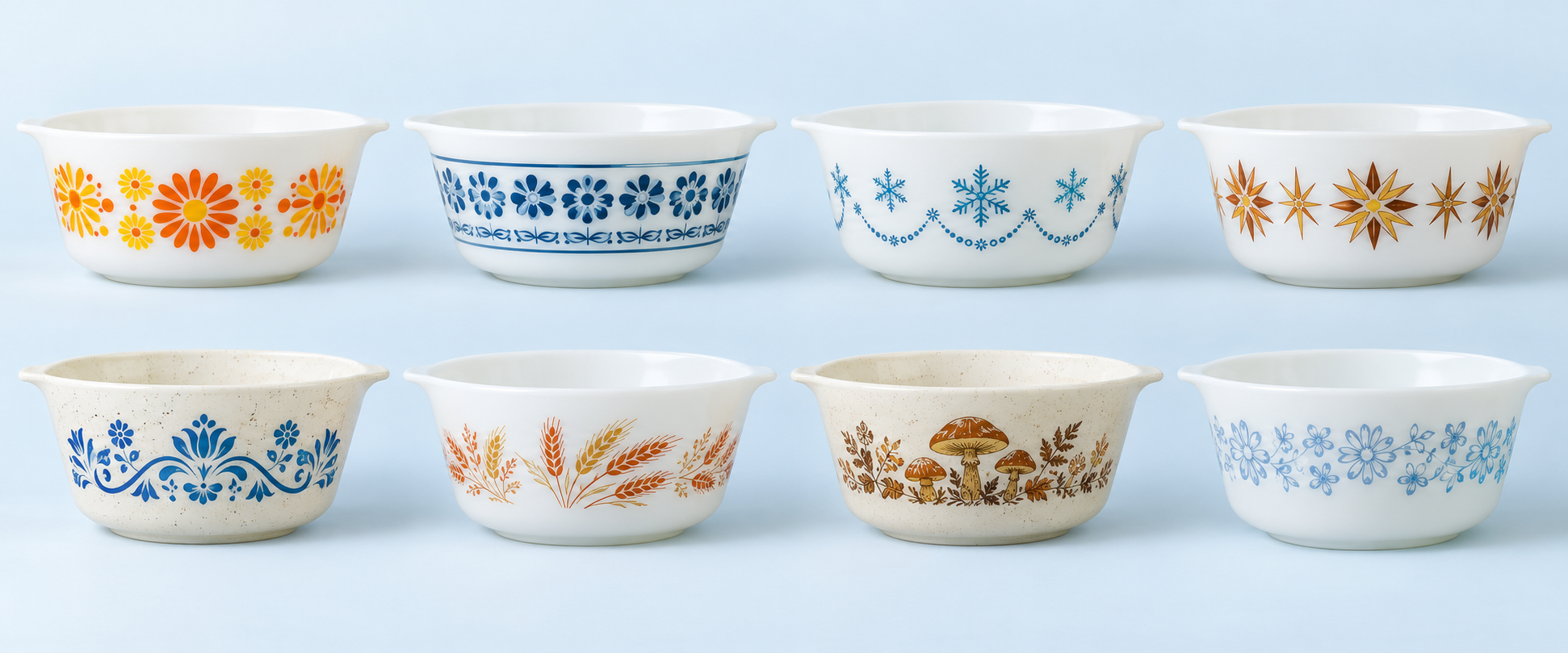
| Pattern family | Documented production period | Identification note |
|---|---|---|
| Daisy | 1968-1973 | Bright orange and yellow daisy designs. This is a different family from the earlier Pink Daisy pattern. |
| Horizon Blue | 1969-1972 | Layered blue floral bands released in a relatively compact collection after the Apollo 11 moon landing. |
| Snowflake Blue | 1972-1975 | Blue snowflakes, swags and dots. Snowflake Garland is a common collector alias. |
| Town and Country | 1963-1967 | Brown, orange, yellow and white geometric designs produced in several mix-and-match variations. |
| Homestead | 1976-1980 | Blue folk-art scrolls on speckled beige, followed by a brown design on solid beige. |
| Autumn Harvest | 1979-1986 | Wheat-sheaf decoration in rust, orange and ivory. Autumn Harvest Wheat is a useful search phrase. |
| Forest Fancies | 1981-1986 | Mushrooms and forest-floor imagery on an almond-speckled background. |
| Colonial Mist | 1983-1986 | Delicate blue-and-white floral decoration and the final opal Pyrex pattern introduced before production ended. |
Common Pyrex pieces you may find
The pattern is only part of the identification. Piece type, model number, capacity and original accessories help buyers understand exactly what is being offered. These are useful starting points for pieces sellers commonly encounter.
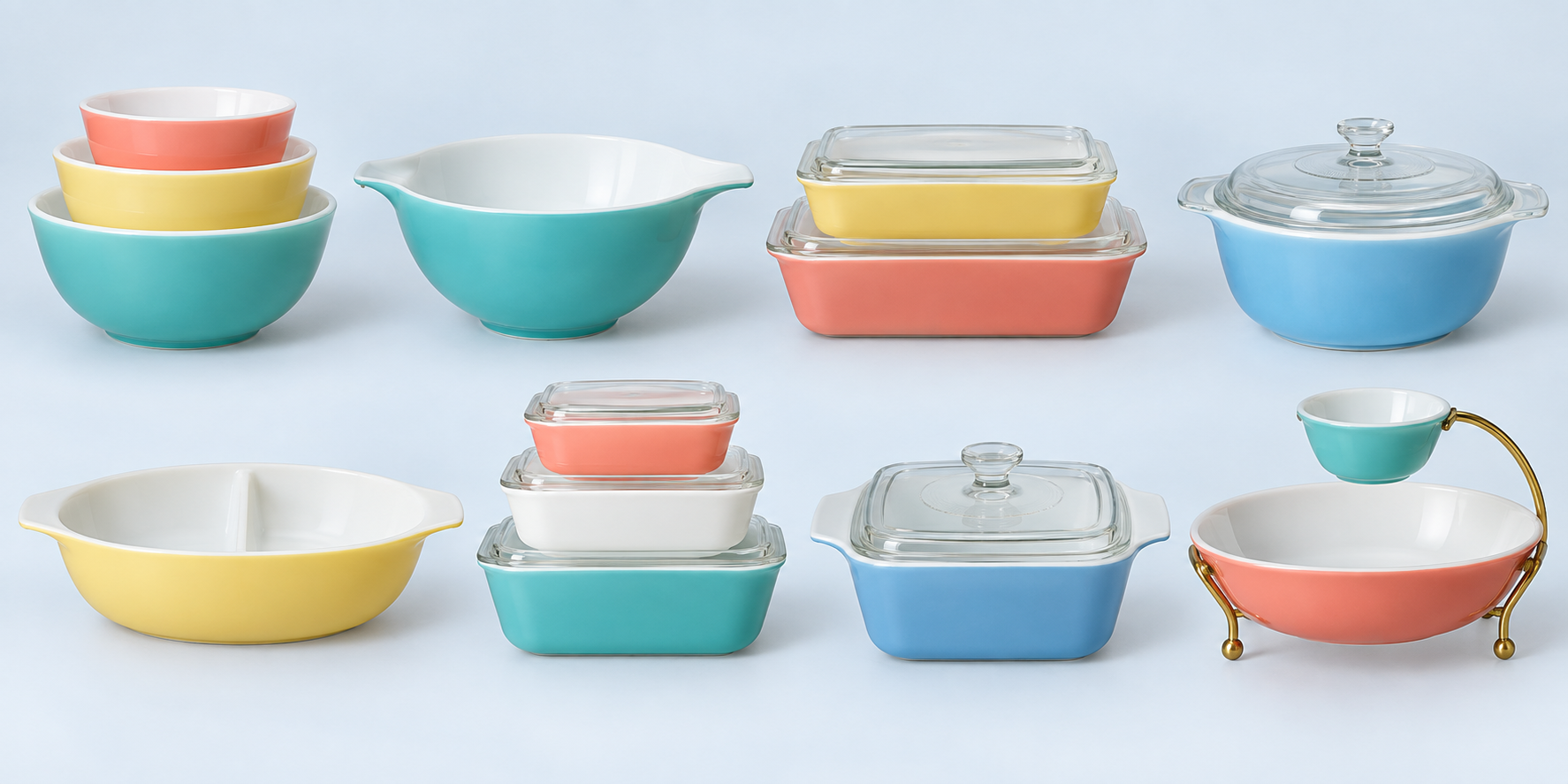
| Piece type | Model clue | How to recognize it | Seller check |
|---|---|---|---|
| Nesting mixing bowls | 300 and 400 series | Standard round bowls sold individually and in graduated sets. | Record the model number and diameter. Do not describe a partial group as a complete nesting set. |
| Cinderella bowls | 440 series | Mixing and serving bowls with opposing handles that also function as pouring spouts. | Check both handles for chips and photograph the model number, capacity and pattern placement. |
| Refrigerator dishes | 500 series | Rectangular oven, refrigerator and freezer dishes originally sold in several sizes with clear lids. | Confirm that the lid fits correctly and disclose chips around both the dish and lid rims. |
| Round casseroles | 470 and 480 sets; individual numbers vary | Covered round dishes sold individually and in coordinated casserole sets. | Match the lid to the dish rather than assuming every clear lid is original to that piece. |
| Oval casseroles | Commonly 043, 045 and 063 | Oval baking and serving dishes, including divided versions, often found with clear or decorated lids. | State whether the dish is divided and whether its lid is present, fitted and undamaged. |
| Bake, Serve & Store dishes | 470 series | Coordinated covered dishes marketed for baking, serving and storing food in the same vessel. | Identify and price the exact size and completeness instead of relying only on the set name. |
| Space Saver casseroles | Model numbers vary | Square covered casseroles designed to use refrigerator or cabinet space efficiently. | Photograph the square profile, handles, model number and any cradle or lid included. |
| Chip-and-dip sets | Often 441 and 444 bowls | A larger bowl and smaller bowl originally joined by a metal serving bracket. | A pair of bowls without the correct bracket is not a complete chip-and-dip set; disclose every missing accessory. |
Five checks before you identify a piece
- Pattern: compare the motif, color arrangement and piece type with a documented example.
- Model number: use the embossed number to identify the shape and size. It is not the pattern number.
- Backstamp: use its layout and wording only as a broad dating clue. Mold use overlapped.
- Lid or set: confirm that a lid fits the model and disclose missing or mismatched pieces.
- Condition: inspect the rim, handles, decoration and interior in strong light.
Additional mold letters and production numbers generally do not identify the pattern or establish an exact production date. Some early color ware also lacks the later model-number format.
Condition can change the result
- Check rims and handles for chips, flea bites and rough areas.
- Look across the interior for utensil marks, scratches and loss of gloss.
- Inspect the decoration for fading, paint loss and uneven color.
- A dull, chalky or hazy exterior may indicate dishwasher damage. That damage is generally irreversible.
- Watch for marker touch-ups, added decals and stripped pieces presented as unusual factory colors.
For routine care, the Corning Museum of Glass recommends warm water and a soft sponge or cotton towel and warns against dishwashers, abrasive scrubbers and sharp implements.
Research the exact piece, not only the pattern
Search current and sold listings using the documented pattern name plus the model number, capacity, piece type, color and lid status. Compare complete items with complete items and damaged pieces with similar condition. Asking prices do not establish market value.
A practical listing-title formula
Vintage Pyrex + documented pattern + model number + capacity + piece type + color + lid, if included
Example structure: Vintage Pyrex Pink Gooseberry 442 1.5 Qt Cinderella Mixing Bowl Pink White. Use only details visible on or reliably documented for the actual piece.
Research sources
- Corning Museum of Glass: Pyrex Pattern Library — primary reference for documented patterns and production periods.
- Corning Museum of Glass: Spring Blossom Green — documented examples of mixing bowls, Cinderella bowls, refrigerator dishes, casseroles and serving pieces.
- Corning Museum of Glass: Snowflake Blue — documented piece and set formats across bowls, casseroles, bakeware and refrigerator dishes.
- Corning Museum of Glass: Horizon Blue — documented production dates, designer and available pieces.
- Corning Museum of Glass: Homestead — documented blue and brown versions and the forms on which they appeared.
- Corning Museum of Glass: Autumn Harvest — documented wheat design, colors, dates and set formats.
- Corning Museum of Glass: Forest Fancies — documented mushroom motif, production period and available pieces.
- Corning Museum of Glass: Colonial Mist — documented blue-and-white version and late-production context.
- Corning Museum of Glass: Pyrex FAQ — scope and limitations of the museum's pattern library.
- Corning Museum of Glass: How to Clean Pyrex — preservation and cleaning guidance.
- The Pyrex Collector: Model Numbers — shape, size and lid-number reference.
- The Pyrex Collector: Dating Pyrex Kitchenware — broad backstamp clues and their limitations.
- The Pyrex Collector: Damage — dishwasher damage, scratches and other condition issues.