
When you are sourcing vintage Nike clothing, the neck tag is one of the fastest clues you can check. Nike changed its branding, label colors and tag construction over time. This visual guide groups several commonly documented tag families into approximate eras.
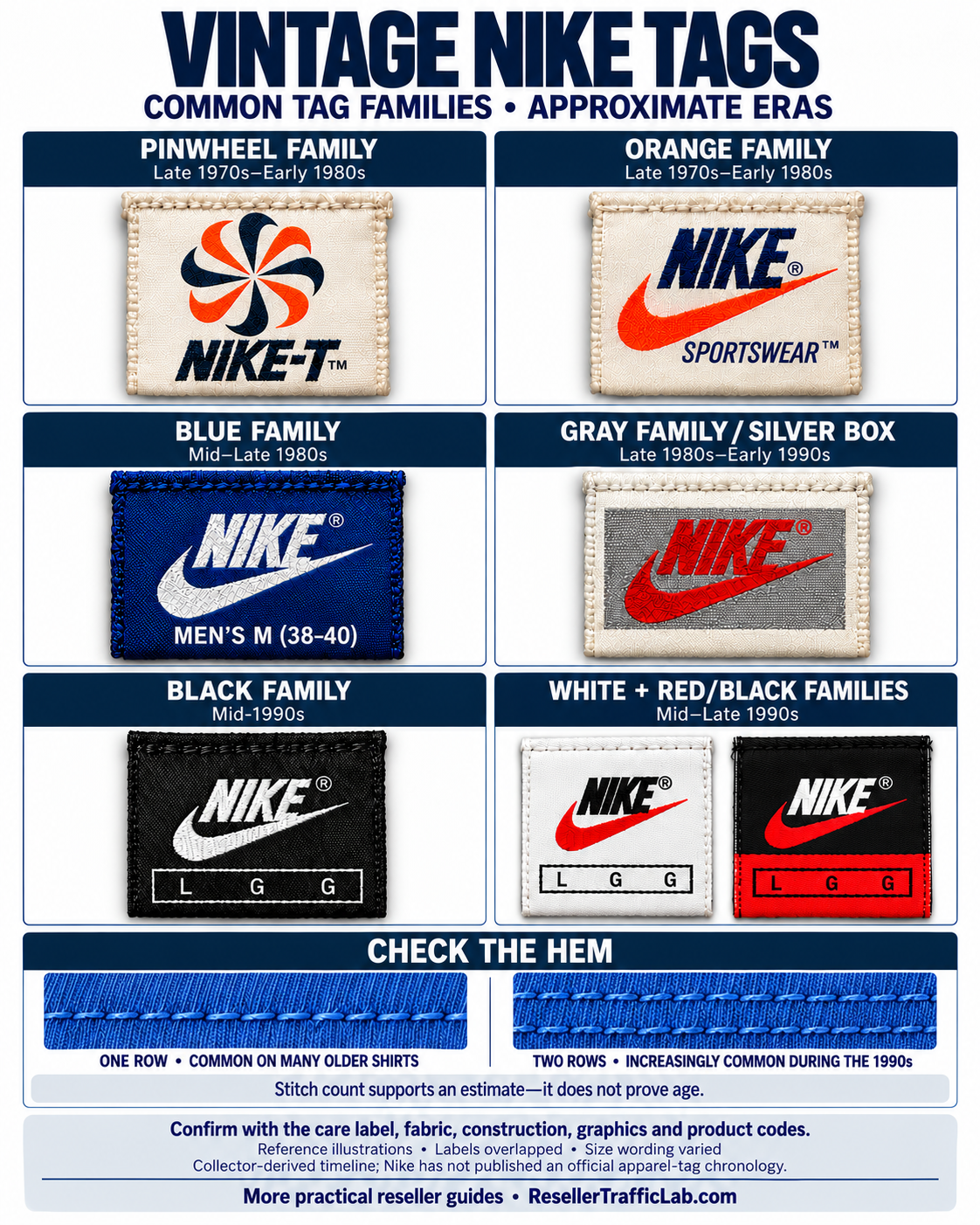
How to use this vintage Nike sourcing guide
- Compare the main neck tag with the closest family shown.
- Treat the listed era as a starting range, not an exact production date.
- Check the care label for materials, country of manufacture and other production details.
- Compare the fabric, garment construction, graphics, hardware and product codes when present.
- Research the specific garment before deciding what it is worth or describing it as vintage.
Nike tag families shown in the guide
- Pinwheel family: commonly associated with the late 1970s and early 1980s.
- Orange family: commonly associated with the late 1970s and early 1980s.
- Blue family: commonly associated with the mid-to-late 1980s.
- Gray family or Silver Box: commonly associated with the late 1980s and early 1990s.
- Black family: a less-common family generally associated with the mid-1990s.
- White and red/black families: commonly associated with the mid-to-late 1990s.
Collectors sometimes give overlapping names or date ranges to similar labels. That is why this guide uses families and approximate eras instead of promising an exact year.
Check the hem as a supporting clue
A single row of stitching is common on many older shirts, while two rows became increasingly common during the 1990s. Stitch count can support an estimate, but it does not prove age. Different factories, product lines, repairs and later reproductions can complicate the picture.
What this guide cannot prove
This is an identification and dating aid, not an authentication guarantee. The tag illustrations are reference recreations and multiple label variations existed. Size wording also varied. Nike has not published a complete official chronology covering every apparel tag, so collector research should be cross-checked against the garment in hand.