
Pattern names can help sellers research an item and help buyers recognize what they are looking for. Start with the broad family, compare the scale and arrangement of the lines, and use a more specific term only when the fabric clearly supports it.
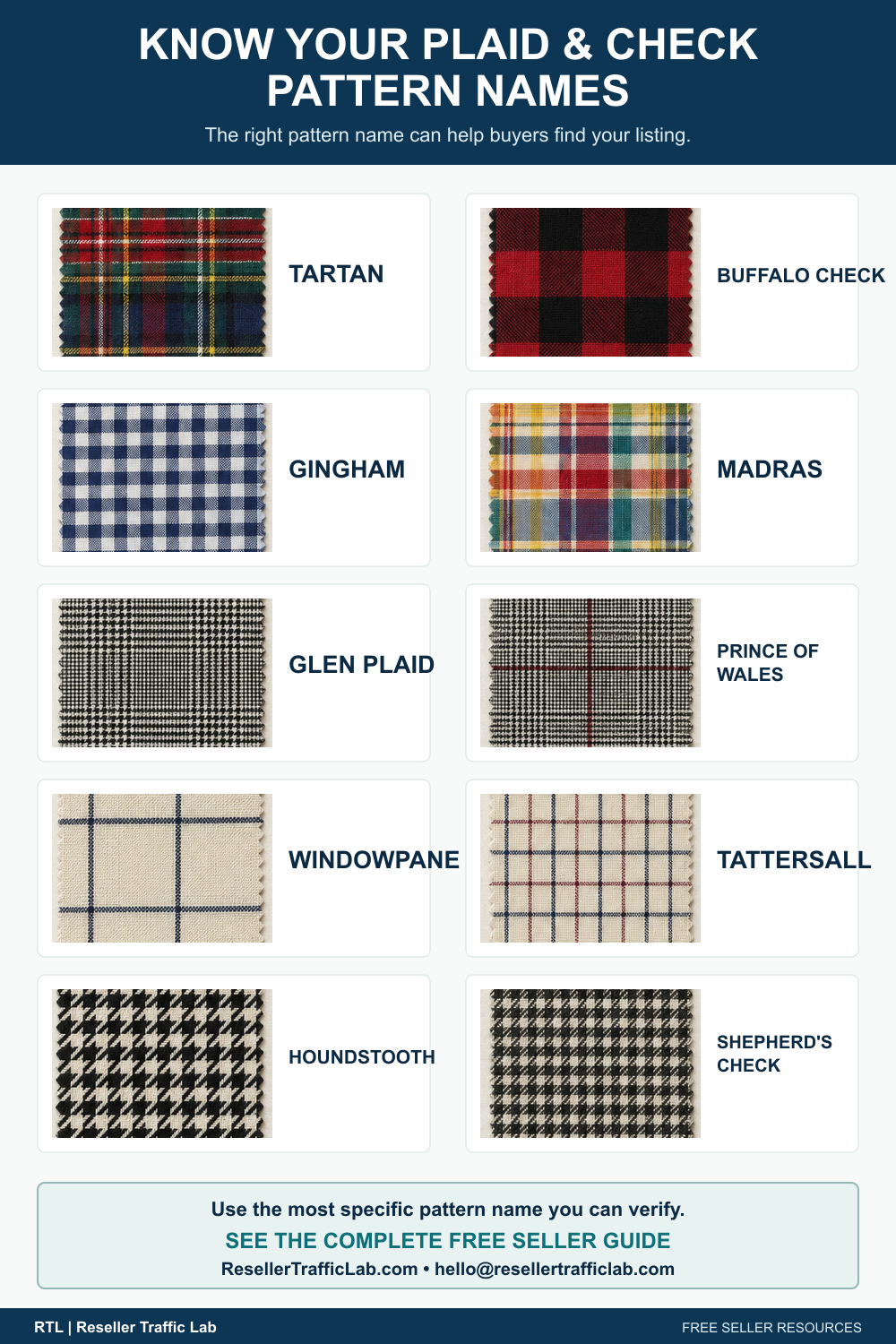
Ten useful plaid and check patterns
Plaid, tartan or check?
These words overlap in everyday clothing listings, but they do not always mean exactly the same thing.
- Check: the broad family of patterns built from horizontal and vertical lines, bands or blocks that form squares or rectangles.
- Plaid: in common American retail use, a broad word for intersecting colored stripes. It may describe a generic design without identifying a documented tartan.
- Tartan: a repeating arrangement, or sett, of colored bands. A specific named tartan should be supported by a reliable reference rather than appearance alone.
For an uncertain item, a clear broad description such as multicolor plaid is better than an unsupported named tartan.
How to recognize the patterns
- Tartan: intersecting horizontal and vertical bands in multiple colors and widths, arranged in a repeating sett.
- Buffalo check: large, equal-sized blocks created by two colors crossing. Red and black is the best-known version.
- Gingham: small, evenly sized checks created by a color crossing a light ground.
- Madras: bright, multicolored plaid associated with lightweight cotton and unevenly arranged stripes.
- Glen plaid or Glen check: a detailed tailoring pattern built from small and large checks.
- Prince of Wales check: commonly a Glen-style check with a contrasting overcheck. Usage varies, so describe what is visible.
- Windowpane: widely spaced lines forming large, simple squares or rectangles.
- Tattersall: thin lines in two colors crossing on a light background to form a regular grid.
- Houndstooth: a broken check with jagged, tooth-like shapes.
- Shepherd's check: a small repeating check traditionally produced with a twill structure.
More check terms sellers may encounter
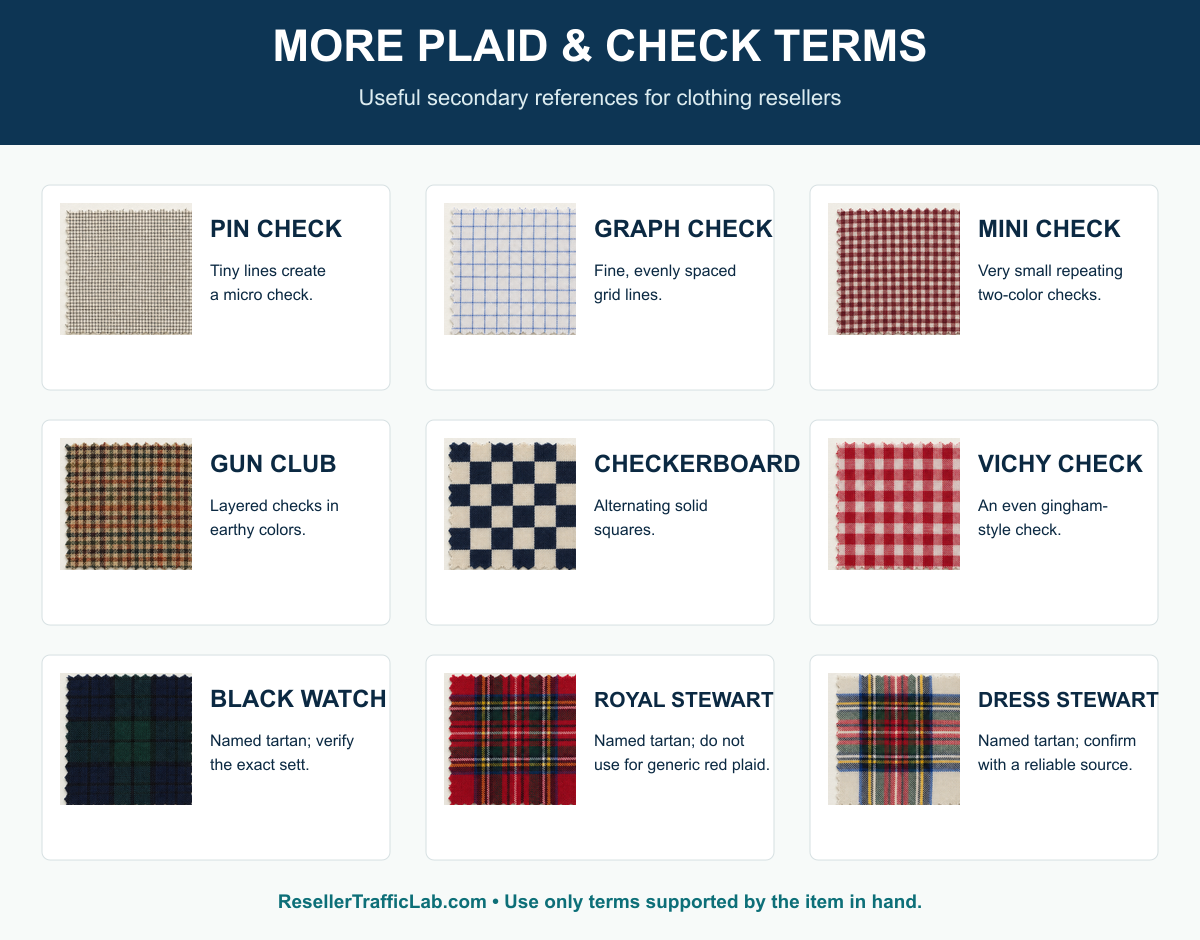
- Pin check: extremely small lines or dots that form a check visible mainly at close range.
- Graph check: fine, evenly spaced lines resembling graph paper.
- Mini check: a practical broad term for very small repeating checks when a more exact family cannot be confirmed.
- Gun club check: overlapping checks, often in earthy colors and commonly associated with tailored clothing.
- Checkerboard: alternating solid squares rather than intersecting bands.
- Vichy check: a term frequently used for an even, gingham-like two-color check.
- Puppytooth: a small-scale version of houndstooth. Retailers may also use small houndstooth or dogtooth.
- District check: a family of Scottish estate checks that includes Glen checks and related small checks, sometimes with a contrasting overcheck.
- Overcheck: an additional larger check laid over a smaller base pattern. This is a useful visible feature even when the precise named family is uncertain.
Patterns that are easy to confuse
Scale, color and retail convention can change the name applied to a pattern. Use the visible structure as your starting point, and treat the distinctions below as identification guidance rather than an authentication guarantee.
| Often confused | A practical distinction |
|---|---|
| Gingham and buffalo check | Both use even two-color checks. Buffalo check is normally much larger and bolder; gingham is typically smaller and shows a blended middle tone where colored bands cross. |
| Glen plaid and Prince of Wales | Usage varies. Many retailers use the names interchangeably; a useful stricter distinction calls the pattern Prince of Wales when a contrasting overcheck is added to a Glen-style base. |
| Houndstooth, dogtooth and puppytooth | They share the same broken, pointed check structure. Dogtooth is frequently another name for houndstooth, while puppytooth usually describes a smaller scale. |
| Windowpane and graph check | Both use thin grid lines. Windowpane leaves large open areas; graph check uses closer spacing and resembles graph paper. |
| Tattersall and graph check | Tattersall normally uses thin lines in two or more colors on a light ground. Graph check is commonly a single-color, evenly spaced grid. |
| Shepherd's check and small houndstooth | Both may be woven in twill and appear similar at small scale. Shepherd's check reads as an even repeating check; houndstooth has more pronounced jagged, tooth-like extensions. |
| Checkerboard and woven checks | Checkerboard uses alternating solid squares. Woven checks such as gingham normally show a third blended tone where colored warp and weft bands cross. |
The pattern name does not tell you the fiber
A plaid or check may be woven, knitted or printed, and the same pattern can appear on cotton, wool, polyester or blends. Record the fiber from the garment label whenever possible. Likewise, flannel describes a fabric rather than a plaid pattern, and tweed should not be assumed solely from a windowpane or Glen-style design.
Use pattern words in a resale listing
- Confirm the brand, garment type, tagged size, fiber content and care information.
- Choose the broad pattern family first: plaid, check, houndstooth or another clearly supported term.
- Add a specific subtype only when the scale, colors and structure genuinely match it.
- Use accurate color words and complete the available pattern, material and style item specifics.
- Photograph the full garment and a close view showing the pattern clearly.
A practical title phrase might read women's wool-blend Glen plaid blazer or men's red black buffalo check flannel shirt, provided every word is supported by the garment and its labels.
Do not guess a named tartan
Black Watch, Royal Stewart and Dress Stewart are named tartans, not generic color descriptions. Many commercial plaids look similar, and established tartans can have multiple recognized variants. Use a named tartan only when the item label, maker information or a reliable tartan reference supports the identification. Otherwise, describe the visible colors and use a broader term such as multicolor tartan plaid.
Research sources
Terminology varies between American and British usage and between textile, tailoring and retail references. These sources were used to cross-check the distinctions presented here.
- The Scottish Register of Tartans — official register used to check named tartans and documented variants.
- The Weavers' Company: Glossary of Weaving Terms — district checks, Glen checks and dogtooth construction.
- Pladra: The Plaid Handbook — visual explanations of tartan, windowpane and Madras.
- Plaid Lover: Complete Guide to Plaid Patterns — comparisons among commonly used plaid and check names.
- Permanent Style: Guide to Checked Shirt Patterns — graph check and Tattersall terminology.
- eBay Seller Center: Item Specifics — guidance on adding accurate item details that help buyers filter and find listings.