
Quick answer: Start with the model number and fit, but never buy on the number alone. Size, wash, fabric, age, condition and buyer demand can make two pairs with the same model number perform very differently.
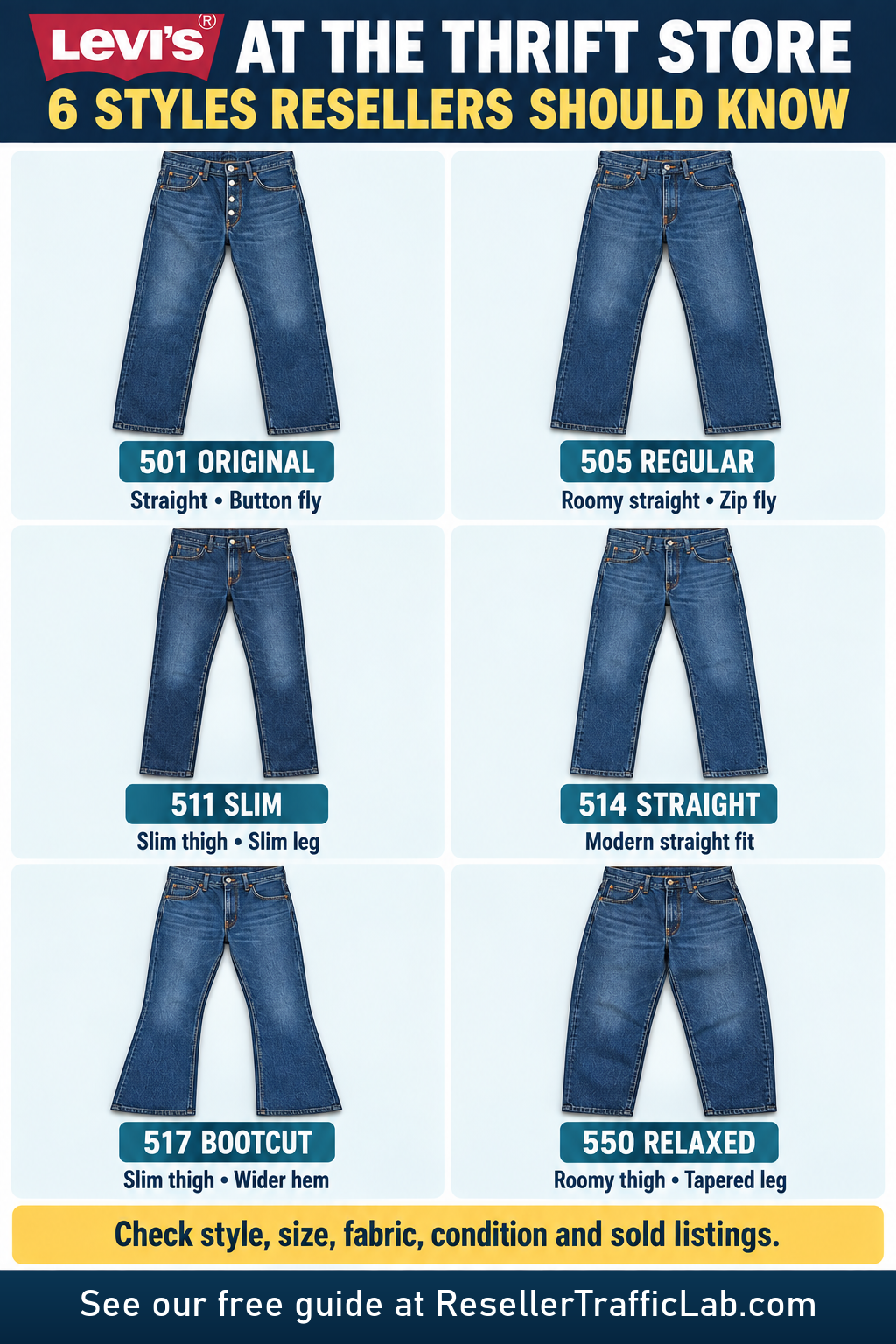
Six styles resellers commonly encounter
This is a recognition list, not a ranking of eBay sell-through rates. Use eBay Product Research or carefully matched sold listings before buying inventory.
| Style | Fit | Fly | Sourcing note |
|---|---|---|---|
| 501 Original | Straight | Button fly | The best-known Levi's number. Check fabric, wash, country, age clues, measurements and condition before assuming one pair compares with another. |
| 505 Regular | Roomy straight | Zip fly | A long-running straight fit. Older USA-made, unusual wash and desirable-size examples may require different research from ordinary modern pairs. |
| 511 Slim | Slim thigh and leg | Zip fly | Common modern Levi's. Do not buy on the model number alone; compare size, fabric content, condition and recent sold listings. |
| 514 Straight | Modern straight | Zip fly | A practical contemporary fit that is commonly encountered. Treat it as regular inventory unless another feature creates specific demand. |
| 517 Bootcut | Slimmer thigh, wider hem | Zip fly | Vintage, USA-made and Orange Tab examples can differ materially from recent production. Confirm the date and complete model information. |
| 550 Relaxed | Roomy thigh, tapered leg | Zip fly | Often associated with relaxed 1990s styling, but production spans multiple periods. Measurements and fabric matter. |
Levi's styles at a glance
How to read a Levi's care tag
- Photograph both sides. Important numbers may be split between the front and reverse.
- Find the style or PC9. Levi's uses the PC9 to identify the product style and finish; it is not automatically the production date.
- Check the button stamp. On many older pairs, the number behind the top button is a factory code that may also appear on the care label.
- Identify the tag format. Production codes changed over time. A number can only be decoded after the label era and layout make sense.
- Confirm the conclusion. Country of origin, construction, hardware and other details should agree with the proposed date.
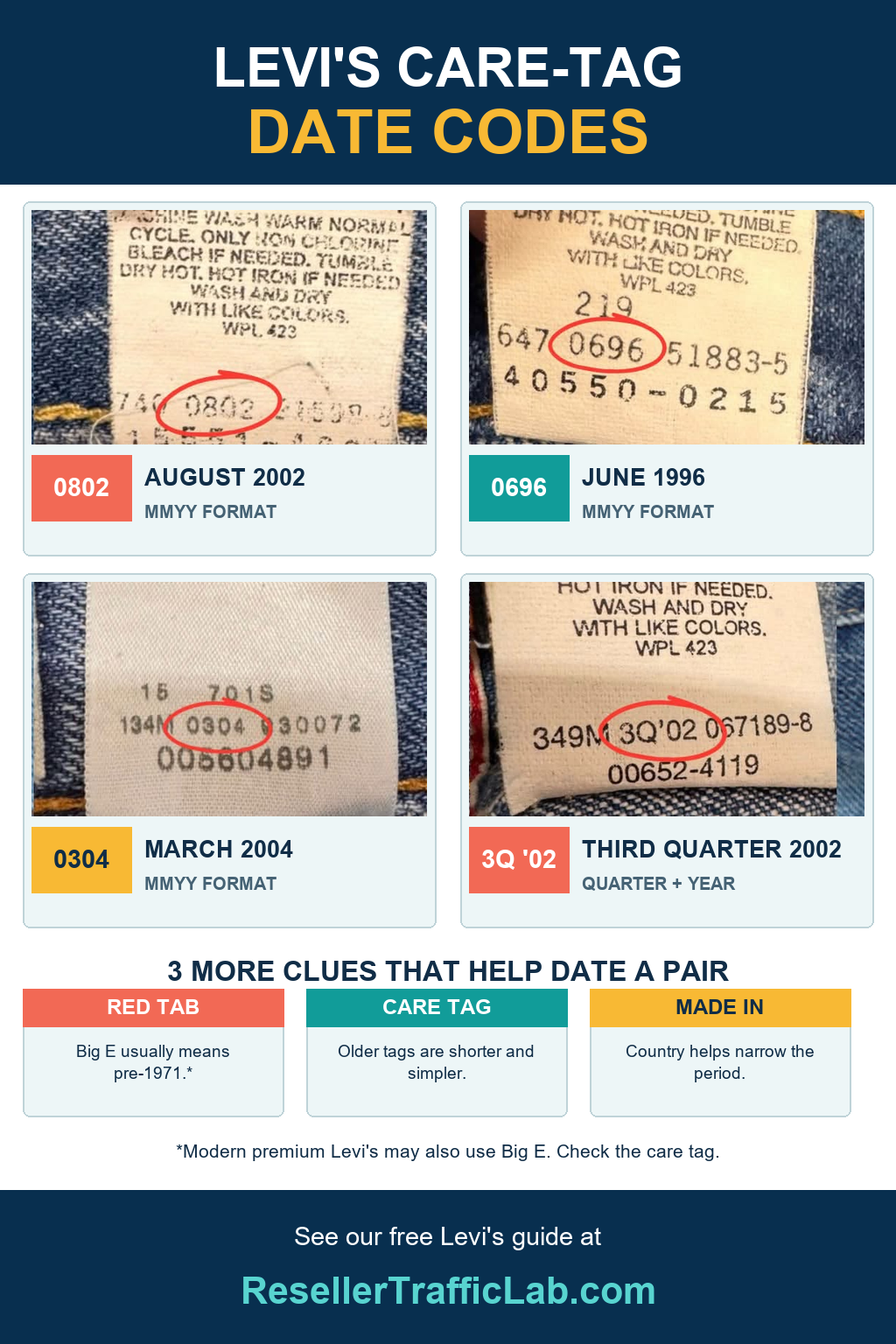
0696 reads June 1996, 0802 reads August 2002, 0304 reads March 2004 and 3Q '02 reads third quarter 2002. Do not apply those interpretations blindly to a different label design.Four care-tag date-code examples
Examples from the 1980s
Many applicable 1980s tags use an MMY format. For example, 046 can indicate April 1986 and 127 can indicate December 1987. Some later tags use four digits, such as 0988 for September 1988. Because the decade may not be written in full, the care-label style and surrounding construction must establish that the final digit belongs to the 1980s.
Details worth a second look
| Detail | What it can tell you |
|---|---|
| Big E | Original red tabs reading LEVI'S with a capital E generally indicate production before 1971. Modern Levi's Vintage Clothing and premium reproductions can also use Big E styling, so confirm the care label and construction. |
| Orange Tab | Levi's introduced Orange Tab for more fashion-oriented products in the late 1960s. It appears on many 1970s-1990s garments, and later reproductions or revivals mean color alone is not an exact date. |
| SilverTab | A distinct Levi's line strongly associated with loose and baggy 1990s styling. Read the complete care label because the SilverTab name has also returned on newer products. |
| Selvedge | The self-finished denim edge visible inside the outseam. Levi Strauss says regular 501 production largely moved away from selvedge around 1984 as wide looms replaced narrow looms. Premium and reproduction jeans later brought it back. |
| Made in USA | Levi Strauss closed its remaining U.S. sewing and finishing operations around the end of 2003 and early 2004. Later limited or contracted USA-made products exist, so this wording supports research but does not establish value by itself. |
| Black batwing care label | A black version of the batwing care-label design appeared around 1991 and overlapped with red versions into the early 2000s. It is a label format, not the SilverTab product line. |
A practical thrift-store workflow
- Read the model number and identify the general fit.
- Check whether the jeans are men's, women's, youth or a special line.
- Read the fiber content; stretch blends and 100% cotton versions can fit and sell differently.
- Photograph the complete care label, back patch, pocket tab and button stamp.
- Measure the actual waist, rise, inseam, thigh and leg opening.
- Inspect the crotch, hems, knees, pockets, zipper and belt loops for wear or alterations.
- Search sold listings using the model, gender, size, wash, fabric, country and verified era.
- Compare sold quantity with active competition before deciding what the pair is worth to you.
Photographs and facts buyers need
- Front and back views showing the complete silhouette.
- Back patch, pocket tab and complete care label.
- Button fly or zipper and the reverse of the top button when relevant.
- Actual measurements rather than relying only on the printed size.
- Clear photographs of hem wear, crotch wear, repairs, stains and alterations.
- Accurate fabric content, country of origin and model information copied from the garment.
Research sources
- Levi's official FAQ — fit information, Big E background and care-label history.
- Levi Strauss: The Story of Selvedge — official history of selvedge and the production change around 1984.
- Levi's: What is a PC9? — official explanation of the product code.
- Levi Strauss 2003 North American plant-closure announcement — primary company statement filed with the SEC.
- JeansZa: batwing care labels — visual examples and decoding conventions that should be checked against the complete garment.
Levi's label formats vary by product, country and period. This guide is a research starting point, not an authentication, appraisal or guarantee of resale demand.